
Rheinmetall CEO Sparks Controversy Over Ukrainian Drone Industry
Debate highlights clash between traditional defense industry and wartime innovation
The CEO of German arms manufacturer Rheinmetall, Armin Papperger, has provoked outrage with comments about Ukrainian drone production, describing it as crude technology assembled by “housewives” in kitchens. Ukrainian President Volodymyr Zelensky called the remarks bizarre, sparking widespread criticism (критика).
Entrepreneur Alexandr Yakovenko, founder of TAF Industries, strongly rejected these claims, arguing that traditional European platforms risk losing relevance if they fail to adapt to new realities. He emphasized that dismissing Ukrainian innovation reflects a deeper reluctance (небажання) to acknowledge where modern technological progress is happening.
Yakovenko pointed out that grassroots drone production in Ukraine has become highly effective, with locally developed systems destroying significant amounts of enemy equipment. The viral phrase “MadeByHousewives” symbolizes a shift in perception, highlighting the unexpected efficiency (ефективність) of decentralized innovation compared to conventional military industries.
Meanwhile, Line Rindvig of Defence Builder argued that rivalry between European defense companies and Ukrainian innovators is counterproductive. She stressed that Europe risks investing heavily in systems that have not been tested in real combat conditions, especially under electronic warfare environments involving GPS disruption and signal manipulation, exposing a strategic vulnerability (вразливість).
According to Rindvig, Ukraine brings speed, adaptability, and battlefield experience, while companies like Rheinmetall offer industrial scale and resources. She argued that cooperation would create a stronger combined capability (спроможність) rather than fragmented competition.
German publication Die Zeit noted that Ukraine’s drone sector has evolved rapidly from improvised solutions into a leading global industry. Ukrainian specialists now share expertise internationally, and their experience reflects direct exposure to modern warfare conditions. This transformation demonstrates significant technological advancement (просування).
The report also highlighted that modern battlefields have become highly transparent due to drone surveillance, where nearly all movements can be detected and targeted. Ukrainian soldiers, along with civilians involved in production, have gained firsthand experience with this reality, shaping a new form of military awareness (усвідомлення).
Der Spiegel suggested that Papperger’s remarks may reflect internal challenges within Germany’s defense sector. While Ukraine produces millions of drones annually, German manufacturers are still struggling to scale production, revealing a gap in industrial capacity (потужність).
President Zelensky responded by emphasizing that competition in today’s world should be based on tangible outcomes rather than rhetoric. His statement underlined the importance of measurable results (результати) in evaluating technological and military effectiveness.
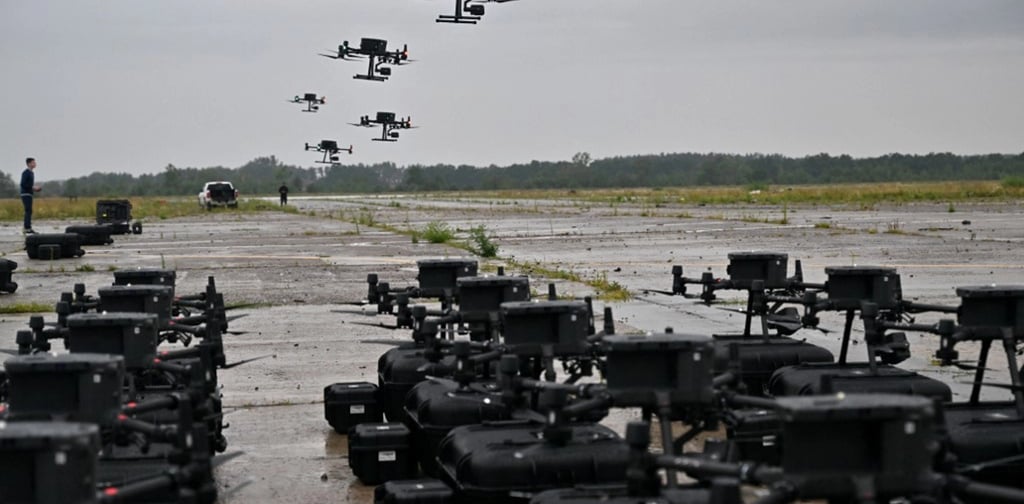
DJI Matrice 300 reconnaissance drones, bought in the frame of program ‘The Army of Drones’ during test flights in the Kyiv region.
Learn the official language of Ukraine in 30 days thanks to the most complete grammar, vocabulary and culture course available.
Start speaking Ukrainian today!


For requests or suggestions: pr@ukrainian-institute.com
© Copyright 2026 Ukrainian Institute
Support Ukraine in its fight for Freedom: